


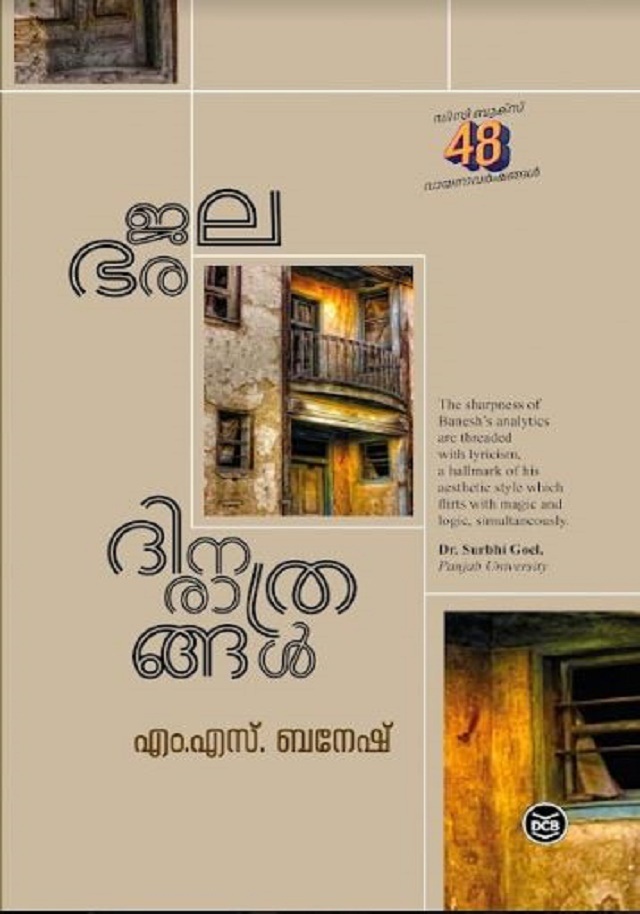
‘Jalabharadinarathrangal’ has been classified as a novel, though the label doesn’t seem to do justice to the genre. What the author has dished out for readers through this book can only be called a chutney of multiple genres—poetry, play, and novel. The writer himself describes his technique as ‘chutnification’. The narrative syntax is permeated with poetry. The narrative itself cannot be called objective or factual; instead, we are served the dance of poetic imagery. Characters behave as if they are acting in a play. In the novel, there seems to be a play within a play, which warrants such behaviour. Since the life and experiences of three people in a family—father, mother, and son—and people close to them are revealed in the form of a story, it can be called a nouveau roman.
In this chutney, you will find spice, salt, sourness, and bitterness in equal measure, though it is low on sweetness. There is a view that the word ‘chammanthi’ is derived from Sanskrit (Sambandhi), while the word ‘chutney’ has origins in Urdu. What makes this narrative, spanning the geographies of Kerala and Bengal, delicious is the right measure of ingredients and their bonding. That this poem-cum-novel, reflecting Bengali and Keralite cultural ethos, is an enticing dish would invariably be realised by those who subsume it.
The three-member nuclear family is by no means a happy family. The protagonist of our novel has been named after the Japanese film director Yasujiro Ozu by his father; he is a son who jots down in his notebook that ‘Father and mother met each other on the pages of a Bible. It was also the space where they quarrelled’; a son who wrote lengthy letters, urging Jesus to mend vessels broken due to fights between father and mother; a son who had to stop writing letters because they were found hanging on trees like paper birds and because his mother learned about the missing inland letters at home—these are the laurels of the protagonist.
The roots of the cold war between his father and mother can be found in their Temperamental Incompatibility. The wife views fictional stories as lies and therefore a sin; the husband sees it as an artistic and aesthetic ideal and the fruit of imagination. Both of them base their arguments on the primacy of the Bible. A husband who believes that men have the freedom to drink and presents stories by Jesus Christ to give credence to it; a wife who is adamant that she would never agree with the proposition. Caught in the conflict between them is the son, who is forced to share his loyalties.
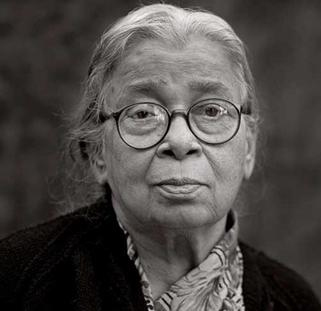
The father has support from none less than Mahasweta Devi, a fiction writer held in high esteem by the people of Bengal. But his mother, who treats fiction as sin, is in the opposite camp. Though the son has no disagreements with films like One day from a hangman’s life, directed by his father, the man feels that [the son] sides with his mother when it comes to fictional films.
The father, disheartened since the son is not siding with him, even issues a ‘threat’ that he would jump off the terrace of the building into the Hooghly River. He doesn’t care what his wife ‘Bency’ thinks, but he can’t digest the thought that his son Ozu considers him a sinner. He wants to resolve the contradiction inherent in his son, who thinks it is acceptable to make a film in which Mahasweta Devi appears as a character but it isn’t to make one based on one of her novels. He shares a deep bond with Mahasweta Devi that is warm enough to expect an intervention to solve a familial dispute.
A Christian couple hailing from Kerala reside on the banks of the Hooghly River. The husband makes films and establishes a deep friendship with Mahasweta Devi, a bond that is strong, like that of a blood relative. He then proceeds to make a film memoir in which his family members appear as characters. Ozu finds similarities between this scroll of memories and the ‘Golden Record’ deployed by NASA in outer space as a permanent record of human civilisation. (Even if man destroys everything on earth through the use of nuclear weapons, the Golden Record has been made in such a way that aliens would be able to infer the story of human civilisation by deciphering the many languages and cultures encoded in it.)
The father expects to have complete support from Ozu and Mahasweta Devi for making this film memoir. Ozu treasures a ‘dinner time story’ inside him, a memory that predates the time his father embarked on the journey to be the maker of fictional films and that of ceramic cups bearing the word DIRECTOR, which connected his parents. The night his father narrates a story from the Bible and lays bare its meanings.
The Bible says that on the day he was crucified, Jesus told the penitent thief that “he too will be with him in paradise on that day.” Since Jesus was resurrected on the third day, his statement that the thief would enter heaven with him ‘today’ was considered to be knotty and untrue. The theological explanation that the father had given for it during the dinner night conversation, however, made the mother happy. The chutney that she made on that day had a special taste. It was also the day the three of them had a happy and contented meal. Ozu thinks that if the moment could be freeze-framed as a family photograph, it deserves the title ‘The Hooghly bank trinity’ and a place in the memory scroll being made by his father.
What makes ‘Jalabharadinarathrangal’ worthy of being called a ‘novel’ is the ‘chutnification’ of the holy trinity of heaven and the humble trinity of earth.
The Malayali Christian family with three members—father, mother, and son—appear as a slice of reality but masked as fiction. The relation they have with Bengali novelist Mahasweta Devi, a real-life persona, is also similar. This transformation, bringing down coconuts from the heights and making them into chutney, is a simple one but reminds one of a couplet from Changampuzha Krishnapillai’s poem ‘Yavanika’, which itself is a translation of Rabindranath Tagore’s ‘Victory.’
Thus truth and falsehood mingle in life
and to what God builds,
man adds his own decoration.
While you have Mahasweta Devi from Bengal as a character in the novel, from Kerala you have Prof. M.N. Vijayan. There is also the wizardry of words that makes the reader experience the unitary quotient of space and time, as elucidated in the Upanishads—’more distant and more closer than it really is.’ The author uses an editing-mixing-cooking technique that excels in forging together the biggest with the smallest and what is farthest with what is near.
‘Jalabharadinarathrangal’ is also the story of the unique bond between a Christian man who hails from the village of Kadamakkudi (a village in Ernakulam district of Kerala) and the Bengali queen of letters, who found him trustworthy enough to hand over signed blank letterheads and cheques. The book also reveals that the letters Deedi wrote to the Chief Minister of Kerala (to register her protest) were made using these blank letterheads.
We can recall here the lines “Thus truth and falsehood mingle in life” here once more.
In the final denouement, or should one say the last rite, the author through a creative sleight of hand gives us a ‘beginning’ instead of an ‘end’. Here the author also drops a hint that Deedi’s blank letterheads had mended the broken DIRECTOR cups without leaving visible marks. After Deedi’s physical remains turn into ‘fiction’ from what is ‘real’, the father and son refuse to travel to her house which has turned into a museum.
The son knew that while stepping inside, it was impossible not to see the chair used by her. This was something unbearable for his father and therefore stops him from undertaking the journey.
The strange last rite, that we come across towards the end, shows the bad blood between the three vanishing. The priests officiating the rite are his father and mother. The first shave of their only son is being staged as a death rite. In mother’s hand there is a bowl of water. In the air, wafting music by Deedi. The father keeps giving instructions to the son like a priest helping to perform last rites. After the end of the ritual, the son wonders:
“Is the first shave equivalent to cutting off the umbilical cord?”
Words keep attaining new forms; metaphors are formed by joining words. The novelty of this work is also linked to the experimentation with the syntax. I will try to provide a few examples here: “Huge bodies stacked in a vast sawmill awaiting their ripping fate”; “Half-full and empty Bisleri bottles stood like sinners with sacrificial air…” The prose is never stale, and the narrative is ridden with wordplay and imagery, which makes the text enjoyable like soft and sweet chutney.
The technique of using words from the last line of a chapter to begin the next reminds us of certain poetic forms. The craft can be easily comprehended even by a casual reader who skims through the book. One could ask what is so special in using a word from the last line of a chapter as the title of the next as if they were links of a chain. We can leave such people alone. Connecting chain links is the duty of goldsmiths, while linking words together is the work of wordsmiths.
There are many such well-known wordsmiths in Malayalam, and MS Banesh is the latest in the line of exceptional writers who can rightly claim the legacy of his illustrious predecessors.
In the final chapter, the reason why Ozu’s mother cannot dismiss the CINema of his father as SIN-ema is the presence of Vijayan Master, who appears as a guiding light. Master considers the sound of coconut scraping as musical.
“The rhythm is perfect…once you enter its cadence it becomes pleasurable, but once you decide to exit, it becomes a distraction,” he says.
The glowing words of Vijayan Master offered a new light to Ozu’s mother. His father’s contention that “it wouldn’t take much time for our civilisation to go extinct; a demented decision by a ruler is enough or even a human error…” played a key role in making her realise that cinema is not sinful, as she had thought.
We also see her listening to the sound greetings from the Golden Record. “The greetings, full of messages of peace, happiness, and warmth, kept drizzling inside the room like music.” Mother was experiencing it in totality.
The realisation that CINema is not SIN-ema helped the mother reclaim her husband. It is the glow in the words of Vijayan Master which aids the metamorphosis in the final chapter and unravels the linkages between film-making and chutney grinding.
In the film made by Ozu’s father, there is a scene in which Vijayan Master climbs a wall to correct the time of a wall clock by turning a key. But the question Master posed while he was being given the instructions for the scene is missing from the film. “Is time something that can be fast-forwarded like this?” It is because of this question that we feel the novel reverberating within us like a metaphysical Jaltarang.
Ozu’s father has a fragile mind, which becomes disturbed while seeing a film of oil floating on the curry made of breadfruit, formed on a tree in the cemetery where his grandfather lies buried. The appearance of Vijayan Master in the film plays a role in making the mother aware of the sensitive mind of her husband. The novel, like a note from a Jaltarang, informs us that ‘Adyam’ or ‘In the beginning’ is the final word uttered by Vijayan Master before his death. ‘In the beginning’, we all know, was water.
The name Banesh is the Bengali equivalent of the Sanskrit word Vaneshan. The word Vanam also means water. Both Shankaghosh and Vaneshan have equal rights to celebrate the ‘nights and days filled with water.’
Dr. M. Leelavathy, now 99, is one of Kerala’s most revered literary critics, writers, and educationalists. A towering figure in Malayalam literature, she is celebrated for her insightful, feminist-leaning critiques of modern Malayalam poetry and fiction.
Translated by Binu Karunakaran from Malayalam
ജലഭര ദിനരാത്രങ്ങള്
രചന : എം.എസ്. ബനേഷ്
പ്രസാധനം : ഡി.സി. ബുക്സ്, കോട്ടയം
വില : 150 രൂപ
No Comments yet!