

There is, if one observes a generally visible demarcation in the ethos of those from the hills and those living in the plains. When coming from the slopes and climbs, the mists, wools, frosts, still hills and their still chills, there settles in you a rigorous calm that embraces the mountain terrain as a regulated reality not a luxury. Nature being the force to reckon with every moment, the young and old dwellers of the hills graduate by acclimatised submission to have a subdued volatility. A forgiving ease informs their natures; a built-in tolerance for hard situations, even patience in the face of delay. They display an enduring friendliness bordering on ignorant innocence of the Plains and its ways, a charm reflective of the formidable hills and heights they have to surmount daily for merely, showing up.
If the first experience of the early morning is freezing temperatures and recourse to warmth from the water you touch, and next, if your limbs are readying to climb or descend, it means you are being trained in a difficult way to be less heated, haughty and already have solutions where the plains dwellers have dainty, fussy problems.
Shaping the Western Ghats are the scenic Blue Mountains covered in centuries of flora and aura. Living here as a child and growing up in the bitter cold and its accompanying conditions l have often thought that scaling the hills upwards with the puffing and short breaths to reach a house, a place of worship or a needed office and balancing with equilibrium down the hill to reach a hospital, school or the markets often with baggage or responsibility, leaves you with no more bandwidth to accomodate things flourishing in the plains — hatred, linguistic differences, polarities in creed and stature, communal disparities, hypocrisy, judgements on things like appearance, wealth, ancestory, social currency, and other mongerings of any sort.
The average person living in a hill station is covered in available weather gear and climbing, descending, driving up or down, gasping at walks up and walks down, braving the heavy price fluctuations for all the things that come up in trucks from elsewhere. Heading to the shivering at their work places first, then to work they head back to the created small or smaller warmth back at their quilty, woodeny, shacky residences, nesting in by dusk, making sense out of the cold, then out of living, every single day.

Similar to the ecology they negotiate each day, a pleasant demeanour and a calm letting go are added to an affable warmth in the innate nature of hill occupants. Till Global Warming, Liberalisation and Privatisation waves took over and denatured even the highest mountains, one would be surprised by the spectrum of domestic, social realities the hill dwellers did hardly develop, have or experience — mosquitoes, lizards, cockroaches, fermented foods, refrigerators, airconditioners, fans, liquid coconut oil, roadside food stalls, crime, arson, casteist supremacy, the culture of eating out, (unless that warm clothes clutcher, wide-eyed and excited is the tourist,) and speed!
People of all diversities, native, settled, immigrant and floating, unthrilled by the thrill of the backpacker, amused by the seasonal visitor mingle in an unforced harmony, a weather connected fraternity that lets the clime do the talking to the living — putting, forced models of national integrity to shame. People from all parts of the country work, settle and dwell for different reasons on the Blue Mountains with a grateful affection for its essence. The dynamism of the towering mountains is a reminder of strength and character, charisma and eclecticism of a community to have which, you need not be rich, educated, endowed or privileged, you only need to live among the scaled hills, warm cottages, cold houses, humble tenements and glorious woodlands.
As a person from those scenic Western Ghats scaling up and scampering down hills l have watched panters and puffers smoothening out their movements with a resigned yet aware ease in their existence. Nature, grows on you in your life as that difficult sibling loved unconsciously. The hillsider’s fraternal relationship with extreme temperature and uneven land is a reality he takes as a given. You begin to get amused and dismissive of camera-excited sightseers, trekkers, hikers, honeymooners and tourists going dizzy-crazy over normal things about your mountains or cold draughts or sights and freezes that you bonded with like the back of your hand.
One experience amongst all in the Blue mountains stands very close to the heart and is a put away, go-to charm in the highly commercialised, irreversible atmosphere of today.
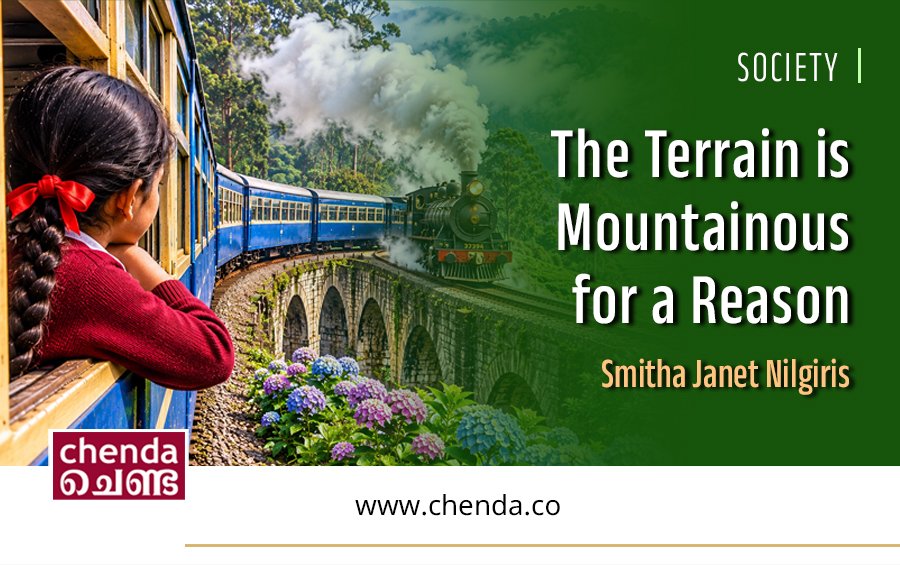
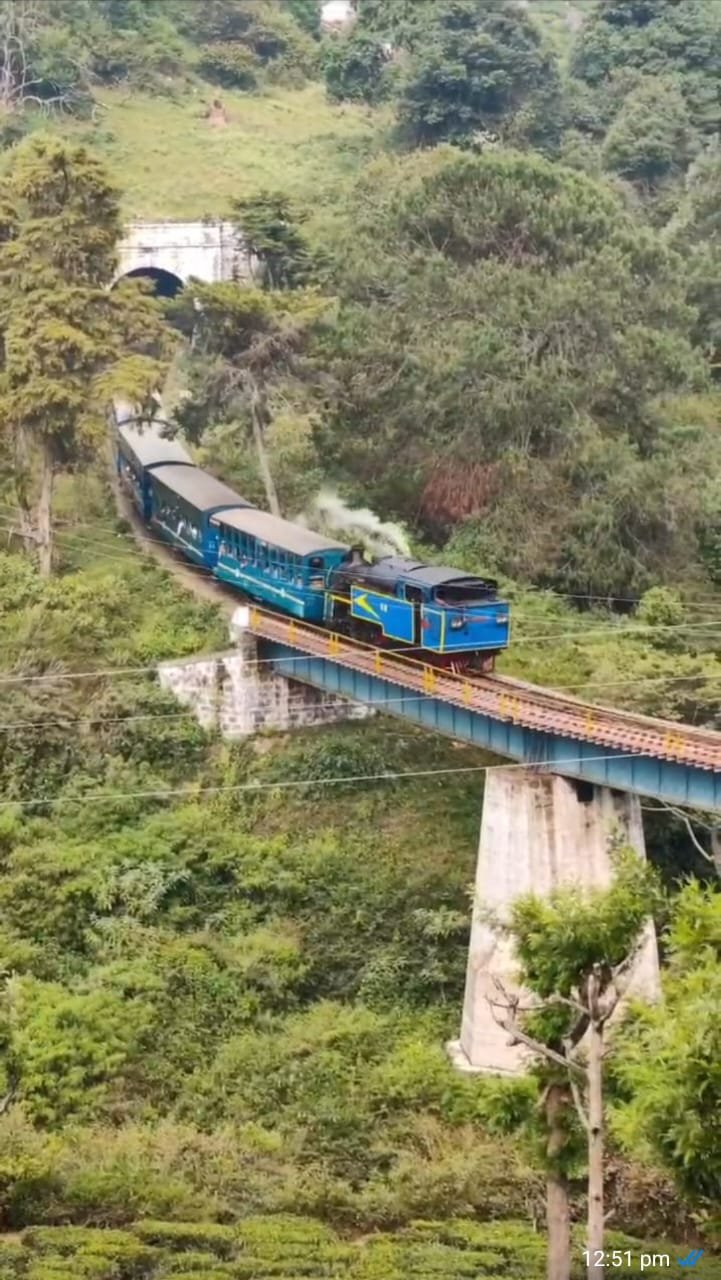
The mountain railway in the Nilgiris has had its toy train chugging along the racks between the rails since the beginning of the 20th century. Trailing constantly for five hours up and another five down to cover one leg of 46 kms alone, the train has endeared itself to everyone along the 250 bridges across pretty pebbled streams, 15 mountain cut tunnels, expansive hilly greenscapes, and more than 200 curves negotiated uphill on the tracks in its petite little avatar.

The Steam Engine roars at the helm as the grand old man of World railways carrying a century old arrogance unparalleled by modern transport logistics.
lnspiring nostalgia and history with its majestic hoot it declares ‘you cannot find another handsome and happening replacement for me, try as you may, can you?’
For simple friends, acquaintances and families known to me from childhood, the train was neither a tourist attraction nor World Heritage property. It was the only means of transport from some areas to others and it was a climb saver. ln some parts of the train’s journey you can walk alongside it without intimidation, excitement, enthusiastic fervour and even fear of losing track of it. That’s when the engine lets off steam and slows down the already slow down. One cannot call it a time saver.
After lndian lndependence it carried working families, folks, goods and essentials to the town in very limited numbers. Initially it was the means of accessibility for Britishers their work and workers to the Hill station, Ootacamund.
You are transported in the spirit of British industrial revolution infrastructure through tunnels, bridges, flowers and rich foliage to reach Ooty, Ketti, Wellington Coonoor or further down to the foothills, if you had the patience more than the purpose.
I would travel everyday from Lovedale to Ooty in primary school. My experience of Lovedale was less glamorous than the Boarding School hype around that sleepy small village. Travelling to school by the Mountain Railway in Std l and Std ll from a calm rural location set among potato, carrot and cabbage fields at Lovedale to strict scary school everyday, the Mountain railway was in ways a cold and warm compulsory companion. It was the most normal part of school life then (although l wonder how my family woke me, got me ready and out on those tiny-shoes feet and warm clothes on the train). After steep uphill climbs few from the house, the station would emerge in the misty morning cold. The terrain l could have the luxury by train was the distance my father would go on foot to his childhood classes. l remember a sparsely populated, laidback Town Ooty announcing the British Kingdom’s footprints and handiwork loudly at every place you looked at. The typical miles to go before the town slept though the woods are all they can pristinely be, was pre millennial Ooty. And l watched and watched the hills and its beauty for two full toddler years as pines, dahlias, tea estates and the everlasting, never-fading yellow flowers as we called them passed majestically by my train window.
My school teacher mother, newly introduced to Hill station living by naturally being married from the plains sometimes carried me, at others held me and her things in the daily work-life-child balance to the same school and same train with the bright blue and brighter cream train boxes lined up. Inside that scary black huge steam engine threatening me was all the Engineering my little frightened mind could hardly, visually handle. It spewed noise and steam at any unsuspecting moment, and like a character from cartoon clips one almost jumped on both feet if walking near that engine when it belched.
I should keep away from the long thin tall glass windows and shut my eyes tight in tunnels for flying coal splinters to not enter and hurt. l remember writing my Math homework of 1–99 in vertical lines on the brownpaper wrapped square-ruled grid notebook on my way back in the train (too young for three digit numbers and four letter words yet). Two long walks to both stations everyday and l would doze off on reaching home at Lovedale. I recollect the fond yellow rectangular tiffin box with white lid, the bread and hot dal curry poured over it to have in the train as breakfast and the elongated elephant faced waterbottle, trunk and ear as handle. What was a 5 to 5.5 kms train ride took a few children’s morning and evening away in temporal spatial dimensions incomprehensible at that age. All l knew was someone must help me up the high train with my bag, uniform, sweater, blazer, and waterbottle into the safety of a wooden room before that engine frightened me with sound and fury as the train arrived. Another scare l dared not look at, waited inside the train. The doorknob was massive, a prominent cream coloured presence watching me if lm looking at it. The turnable, securing strong knob was palm wieldable to big uncles and aunties. It had a character. lt looked like a weapon for enthusiasts to not fall off excited bridges and ravines. The psyche was disturbed when being put into the high doors. The barking steam locomotive demon and knob demoness, now endearingly missed, prided about were all there then in daily attendance.
Tunnels were fun because the lights come on. That bulbs would definitely light your space even in bright daylight was a wager guarantee. Yellow, friendly, comforting lights that never let you cross the noisy, chuffing, roaring, sometimes minutes long dark eerieness, came on at the hint of a tunnel. At curves, very frequent and predictable l loved seeing the four or five boxes make a C where the engine and the last box were visible with its people inside, bringing us closer as if to say lets brace, for we are in the scary long tunnels together. One uncle in a chequered harsh coat of grey and brown, bellbottom pants, long dog ear collars, side whiskers almost reaching the thick moustache was also always wearing a constant judgemental and annoying look staring at this child-mother duo whenever our journey was in the same box. l was the smallest among the school children to board that train daily. Highly disapproving of baby children travelling, homeworking, eating, sleeping and “suffering” in the train, he would be fussy and irritable and verbal, among poltical things, about being ambitious for big name schools of Ooty at the cost of tortured toddlers. l realised later he was an educated man from the plains, reluctantly taking care of Tea estates for his boss. He would give me the eternally “why struggle thee” look, disparaging of my mother’s unwise decisions. He had a problem with everydaying people and crowds. My mother would not care. Most of her time was spent in valuing answerscripts from her bag or preparing for multifarious classes next day because she had in-law parents to cater to back in the house, after piles of clothes to wash, when tempratures were less chill than early mornings. Our worries were, should the undrying socks go on to the pressure cooker before the whistle came on or whether the sweaters we wear will be dried at the wrist even after two days of sundrying or canvas sports shoes and the PT T-shirt that went up the tiled roof in the morning got wet again in the Evening mist. So no one really considered grumpy fidgety restless, standoffish uncle.
There were a handful of good schools, including mine, up St. Mary’ s Hill, another steep climb from Ooty station for the little cold short feet and plains accustomed mother-teacher with baggage. My mother had only two shawls that were worn distinctively on the inevitable sweaters. She had a regular blood-red shawl she wore everyday and an off-white one for outside occasions. l have hurt the feelings of my mother very unconsciously one day. She had taken leave. She used to converse in the mother tongue with me upto school on our uphill climbs. A very well off older girl going to a rich school on St. Mary’ s Hill regularly beside us with just a smile and no more asked me that day “Your Ayah amma (nanny) did not come today?” Not aware what l was conveying to that dignified teacher who was living in humble submission to geography, house and job, l had inadvertently narrated the query to my mother and hopped off to play. She later shared how she would have nothing but cold cream on her face and that shawl as the only protectants for years from her realities with high cost of living in the hills and that she was in a dilemma next day whether to discard the shawl for her Sunday best, to convey right things to that child.
Dignity and cold prevailed. She wiped her tears after sharing them with my father, wore the same red shawl next days, introduced herself in English to my senior friend on the climb as teacher mother and carried on with her resilient smiles and talks thereafter with us.
That shawl and its texture were representative for years in my memory as the warmth of my mother’s care when l was vulnerable and little. Colour was a distinctive and integral part of my childhood. All shades of green in the natural vicinity were buffered by most unthinkable shades of blue at the mountainous majestic horizons splashed with clear blue skies, white fluffy clouds kissing the mountain peaks and flowers of all hues bordering every pathway, filling every private and public garden. Watching from the train, streams and brooks gurgled amidst the fresh smell of eucalyptus from the dainty silent deep woods and labourer aunties walked alongside the slow train swaying rhythmically based on their loads, carrying firewood placed on a round wound up cloth at their centre heads. l used to wonder if they were scared like me to enter the tunnels on their laden path. For two years, till, we afforded ourselves a better rent, closer home, nearer walk, more shawls and sweaters, my mother took care of my early cold train journeys. l would hold her hand tight, breathless, in my school bag, pigtails, meroon sweater, chocolate brown blazer with a proud school monogram, in those drawn socks, cling trustingly to her unfashionable purposefulness of the eighties, whenever the station approached because at any unsuspecting moment a black monster unavoidable would spew steam, fire and furnace heat or move with metal pistons around huge wheels and come stand before me. That is when l do not know where to look.
It was taboo to ask a homeward bound tired working mother that it was necessary to use the washroom. There were none on the train. lt was a toy like but Century old strength machine of a train that had had British officers and workers transported to build Ootacamund as the Summer headquarters of the regime when Madras Presidency got too hot for endurance. A subtropical clime with temperatures waltzing between 0 to 22 degress was the topographical domain discovered 2500 metres above sea level by the English similar to the places in the British highlands. And the rest is hard lndian legacy not mere history. The short metre gauge holds the little trains intact from the year 1899 with a few track diversions and loop lines at stations alone. The steep rugged environment, its ravines and rocky mountain barriers can hold no more than one track. Inside the train, the little luggage carriers were like elevated hammocks, right enough for that Western luggage. Seats were very limited. They are still the same. Only, we have grown up, outgrown the train and it has become a UNESCO symbol.
Uncle-grumpy-by-the-train decided to make Ooty his home, living in a colonial cottage someplace between Charing Cross and Fernhill he told me, when we chanced upon each other at the landmark nineteenth century British Library many many decades later. Apparently l could have been the one to recognise him. l was perusing books and studying the architecture there with friends who were visiting lndia after we had conglomerated at a Poet’s meet, South England. Brunching, sharing, reading and aesthete all Summer, some of them had decided to fly down. He was there at the Library. Relaxed. Calmed. The checked coat was gone, he was in his early seventies, the heeled shoes had disappeared so had all the whiskers. He drove a simple white Fiat Padmini to read, wore a Monte Carlo cardigan, a beret style cap, and also an upright no more uptight gait. He now owned more estates than he had served. My British friends told him how we try to keep each other in our poetic huddles and meet once in a suitable while in Europe when possible.
And did he approve of the child doing toddler Mathematics in a chugging locomotive, now appraising British friends of Britain’s legacy in the Blue Mountains? ‘Let me look for old photographs of the train little child’, his voice shivered and eyes shone behind his bespectacled wrinkles. ‘The new train is all tourist friendly and the old one….’ he searched for a word that his eyes expressed better. ‘…Passed, Uncle? Gone by?’ He nodded with a heaving and a warm smile at my childhood self and the friends by my side. It brought alive the smell of coal and eucalyptus all at once into that space.
Is there a stamp of Heritage only on buildings and objects not people and their experiences, when all have been part of the same history of being and meaning?
Smitha Janet Nilgiris is a Poet and Academician








No Comments yet!